New York officials said the 26 Federal Plaza fire was not a random stunt, but a planned attack with weapons, gasoline, and an incendiary device.
Quick Take
- Andrew Arrabaca was arrested after a fire and explosive device incident outside 26 Federal Plaza in Manhattan.
- Officials said he carried multiple weapons and fired pellets toward the federal building.
- The building houses the Federal Bureau of Investigation, Immigration and Customs Enforcement, and immigration courts.
- The Federal Bureau of Investigation’s Joint Terrorism Task Force is handling the case.
Weapons, fire, and the arrest
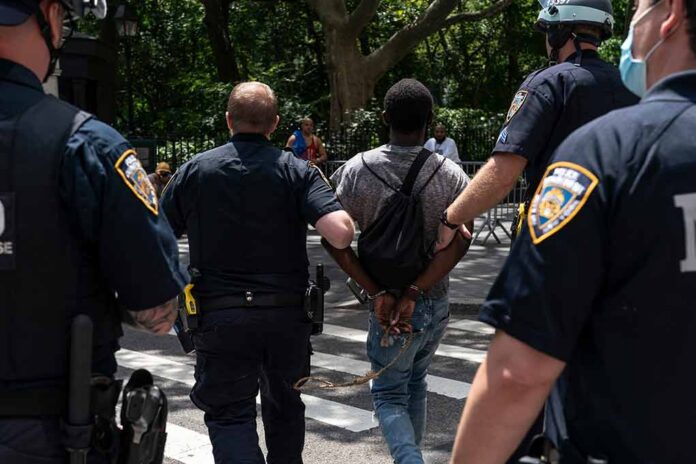
Federal authorities said Andrew Arrabaca, a 43-year-old former United States Army soldier, was taken into custody after the Monday morning incident outside 26 Federal Plaza. The Federal Bureau of Investigation said he used gasoline, a lighter, and fireworks to start the fire, then fired a pellet gun toward the building. Officials also said he carried axes, knives, a hammer, and a machete.
Officials said the scene developed near the employee entrance of a federal building that houses the Federal Bureau of Investigation, Immigration and Customs Enforcement, and immigration court offices. New York City Police Department officers and federal agents responded quickly, and investigators said the fire left multiple people with minor injuries. The arrest ended the immediate threat, but the case now moves into a broader terrorism review.
Why officials are calling it more than vandalism
Federal Bureau of Investigation Assistant Director James Barnacle described Arrabaca as an “anti-American, anti-government extremist” with “bad intentions.” That language matters because the agency is treating the incident as a possible extremist attack, not just a criminal fire. The Joint Terrorism Task Force is leading the investigation, which usually signals concern that the suspect may have acted to frighten or injure people, not only damage property.
News reports also place the case inside a wider pattern of attacks and plots aimed at government and law enforcement targets. A Center for Strategic and International Studies review said that from January 2020 through April 2024, 50 attacks or plots in the United States targeted government, military, or law enforcement sites. A separate analysis found 460 premeditated plots against state targets from 1992 through 2022.
What the case means for public safety
The facts in this arrest point to a larger problem that cuts across politics. Federal buildings, immigration sites, and police-related targets remain high-risk flash points because they can draw anger fast and create chaos in seconds. That is why local and federal officials often treat even a single suspect as a public safety test. The worry is not only the damage done, but how easily one person can trigger fear in a crowded city.
The FBI confirms anti-ICE terrorist Andrew Arrabaca poured gasoline at the employee entrance to Federal Plaza in NYC, and ignited it with a lighter and "incendiary device" Arrabaca had 2 axes, a hammer, machete, three knives, a pellet gun, from which he fired 5-7 pellets
— Alice (@dominic_hewitt) July 21, 2026
For readers frustrated with government failure, this case lands in a familiar place. It shows how quickly public anger can turn into real danger while agencies rush to contain the scene and shape the narrative. It also raises a basic question that many Americans on both sides of the aisle ask more often now: why do federal facilities keep becoming the stage for political rage, and why does the public keep paying the price?