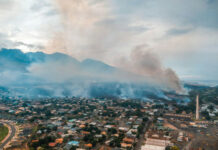
While thousands of Orange County families were forced from their homes by a toxic chemical threat, prowlers and at least one accused looter moved in, turning an already dangerous blast zone into a test of law, order, and basic decency.
Story Snapshot
- Police say seven people were arrested in the Garden Grove evacuation zone, including one for looting and six for prowling.[1][3]
- Roughly 50,000 residents were initially ordered out as officials warned of a possible catastrophic explosion at a chemical tank.[3][4]
- Authorities later reduced the evacuation area to about 16,000 people, but emphasized the crisis was “not over” and hazards remained.[1][3][4]
- High-visibility patrols and technology were deployed to deter criminals from targeting empty homes and businesses.[3]
Police Confront Crime In The Shadow Of A Potential Explosion
Garden Grove residents were first evacuated after a chemical tank incident raised alarms about a possible massive explosion, pushing more than 50,000 people from their homes and businesses across several Orange County cities.[3][4] Officials described a worst-case blast scenario that would have devastated surrounding neighborhoods, prompting aggressive evacuation orders and an all-hands emergency response.[3] While firefighters focused on stabilizing the tank, local police suddenly had to secure block after block of darkened streets, shuttered shops, and empty driveways.[3][4]
Garden Grove Police Chief Amir El-Farra told reporters that officers had already made seven arrests since the emergency began, with one suspect booked on a looting charge and six others arrested for prowling in the evacuation zone.[1][3] Those numbers confirm that criminals did come into the area and that officers were not simply patrolling an empty map; they were confronting real suspects in a high-risk environment.[1][3] For evacuated homeowners, that looting arrest validates long-standing fears that predators rush in whenever government orders law-abiding people to leave.
Evacuation Zone Shrinks, But Security Threats And Hazards Persist
As firefighters and hazardous materials crews cooled the tank and worked through chemical mitigation procedures, Orange County officials gradually reduced the evacuation footprint, cutting it down to roughly 16,000 people while stressing that danger still remained.[1][4] Fire commanders later ruled out a truly catastrophic blast, but they warned that smaller explosions or flare-ups were still possible inside the industrial site.[3][4] That mixed picture meant residents could not simply return to normal, and police were expected to maintain a strong presence over a patchwork of reopened and still-empty neighborhoods.[1][3][4]
Local coverage described extra patrols in the remaining evacuation zone and adjacent areas, with officers using high-visibility patrols, plain-clothes details, and modern surveillance technology to deter more looters from taking advantage of the crisis.[3] This stepped-up policing posture served two purposes: first, to discourage would-be thieves from cruising through darkened streets; second, to reassure evacuees that someone was watching their homes while they were stuck in shelters or hotels.[1][3][4] In practice, it underscored a core reality conservatives have long understood: criminals watch the news too, and they move quickly when government tells honest citizens to get out.
Looting Narrative, Limited Arrests, And The Bigger Question Of Trust
Despite attention-grabbing headlines about “ghouls” in the blast zone, the public record so far documents just one looting arrest and six prowling arrests, suggesting a limited but real enforcement pattern rather than a citywide crime wave.[1][3] Reporters covering the incident have not produced evidence of widespread looting beyond that single charge, and there are no publicly released arrest reports or body-camera videos yet to show exactly what officers encountered.[1][3] That leaves residents weighing official warnings about crime against a relatively small confirmed case count.
Thousands of Orange County residents are returning home as the threat of a catastrophic explosion from a chemical tank in Garden Grove was eliminated. However, the threat of a smaller blast has 16,000 people still under evacuation orders Tuesday. https://t.co/Ben9wyDpYD pic.twitter.com/TcydAAAqKC
— KTLA (@KTLA) May 26, 2026
This gap between fear and documented facts fits a broader pattern seen in natural disasters and emergency evacuations across the country, where concerns about looting spike even when verified incidents remain relatively rare.[1][3] For many Americans, especially those who value property rights and self-defense, the lesson is not to relax but to stay vigilant and demand transparency from authorities who control both the evacuation orders and the security narrative.[1][3] Garden Grove’s experience shows that even one looter in a mandatory evacuation zone is one too many—and that when government disarms neighborhoods by emptying them, it has a duty to prove it is protecting what families were forced to leave behind.
Sources:
[1] Web – Evacuation zone reduced with threat of massive explosion … – ABC7
[3] Web – California firefighters say threat of massive explosion in Orange …
[4] YouTube – Fourth evacuation shelter opens in OC following chemical leak