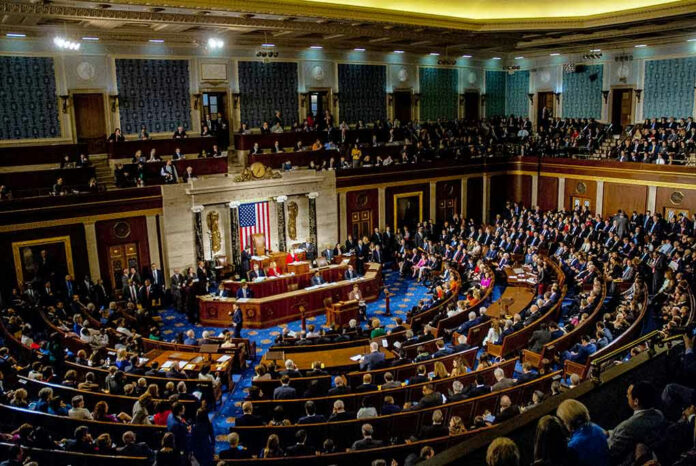
As Washington fights over Iran war powers, the real battle is whether unelected bureaucrats and anti-Trump lawmakers can handcuff the Commander in Chief while Americans are still in harm’s way.
Story Snapshot
- House Democrats and some Republicans are pushing War Powers resolutions to restrict President Trump’s ability to use force against Iran without new authorization from Congress.
- The latest House effort to force a withdrawal from “unauthorized hostilities” in Iran failed 212–219, but showed rising pressure to constrain the White House.[3]
- Supporters claim Congress must reassert its constitutional authority; opponents warn these measures could embolden Iran and undermine U.S. troops.[1][3]
- Legal experts say the long‑running tug‑of‑war over war powers remains unresolved since the 1973 law and is now playing out again over Iran.
Congress Squares Off With Trump Over Iran War Powers
Members of Congress are once again trying to clip President Trump’s ability to respond to Iran, using the War Powers Resolution as their weapon of choice.[1] The latest House measure, House Concurrent Resolution 38, ordered the president to remove United States forces from what it called “unauthorized hostilities” in Iran.[3] That vote failed 212–219, but nearly the entire Democratic caucus and two Republicans backed it, signaling growing appetite to put legal limits on Trump’s Iran campaign.[3]
Earlier efforts went even further, with House Democrats on the foreign affairs, armed services, and intelligence committees introducing a separate resolution declaring that “President Trump must not be allowed to start a war with Iran” without explicit authorization from Congress.[2] That two‑page measure directed the removal of United States forces from hostilities with Iran except to defend the homeland, casting Trump’s actions as overreach rather than legitimate self‑defense.[2] Progressive activists and outside groups have loudly urged passage of these limitations, arguing Trump’s strikes are “illegal” and “reckless.”[4]
How The War Powers Fight Tests The Constitution
At the heart of this fight is the Constitution’s division of war powers between Congress and the president. The Constitution gives Congress the power to declare war and fund the military, while the president serves as Commander in Chief responsible for day‑to‑day operations. The War Powers Resolution of 1973 tried to clarify this balance by forcing presidents to report military action within forty‑eight hours and withdraw forces after sixty days without authorization. Every administration since has claimed broad self‑defense authority, leaving the underlying dispute unresolved.
The Iran conflict follows that familiar pattern of what analysts call “legislative signaling” rather than decisive rollback. Presidents often initiate or expand limited military operations under their own Article II powers, while Congress responds with nonbinding resolutions, messaging bills, or funding threats that rarely force immediate changes.[1] In the current Iran case, House and Senate votes have so far failed to impose binding limits on Trump, even as lawmakers of both parties introduce multiple resolutions and hold high‑profile debates.[1][3] The result is political heat without clear constitutional closure.
What Limiting Trump Now Would Mean For Security And Sovereignty
Supporters of tighter war powers claim they are defending the Constitution, but their approach carries serious risks for American security and sovereignty. Forcing Trump to pull back from Iranian targets on a rigid timetable could telegraph weakness to Tehran’s rulers, who sponsor militias, threaten shipping lanes, and endanger American service members and allies. Cutting off funds or tying the president’s hands mid‑conflict would also shift leverage to Iran’s hard‑liners right when they are testing United States resolve in the region.
The House just passed a War Powers Resolution 215-208 to tie President Trump’s hands in the Iran conflict.
This is the same Congress that has spent years refusing to secure the border, refusing to pass the SAVE Act, and refusing to stop funding terrorist networks — but suddenly… https://t.co/3J4AYsJDsI— Summer (@EclipeByDeath) June 3, 2026
For conservatives, the deeper concern is who truly sets American strategy: a president elected to defend the nation, or a Congress where partisan factions use process maneuvers to advance anti‑Trump and globalist agendas.[1] Critics of the House resolutions argue they are less about constitutional fidelity and more about re‑litigating past grievances over Trump’s foreign policy and aligning with activist groups that routinely label U.S. actions “illegal.”[4] As lawmakers prepare more war powers votes, the outcome will determine not only how Trump handles Iran, but whether future presidents can act decisively when Americans are threatened.
Sources:
[1] Web – As Rubio Declares Iran War ‘Over,’ Lawmakers Prepare War Powers Vote
[2] Web – House narrowly rejects limits on Trump as Iran war drags on – Politico
[3] Web – House Dems. introduce bill to limit Trump’s war powers on Iran
[4] YouTube – US Senate Blocks Bid To Limit Trump’s Iran War Powers