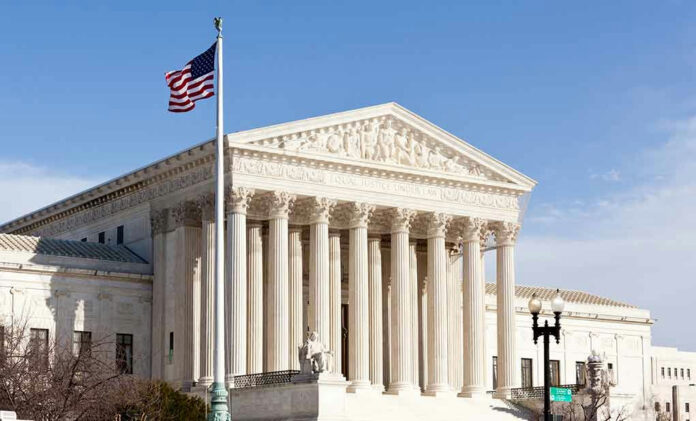
The Supreme Court just told both parties something many politicians do not want to admit: babies born here are Americans, no matter how Washington spins it.
Story Snapshot
- The Supreme Court ruled 6–3 in Trump v. Barbara that nearly all children born on U.S. soil are citizens at birth, even if their parents are here unlawfully or on temporary visas.
- President Trump’s Executive Order 14160 tried to carve out two big exceptions to birthright citizenship but collided with 150 years of law and history.
- The Court’s majority leaned on the 1898 case United States v. Wong Kim Ark, which had already settled birthright citizenship for children of non‑citizens.
- A divided Court left one door open: Congress, not the president, might still try to rewrite parts of birthright citizenship through new laws.
What The Supreme Court Actually Decided
On June 30, 2026, the Supreme Court decided Trump v. Barbara, a case about whether the president can change who is a citizen at birth with a pen stroke. The case challenged Executive Order 14160, which said some babies born in the United States would not be citizens if their parents lacked certain legal status. In a 6–3 vote, the Court said these children are citizens under the Fourteenth Amendment and long‑standing federal law. That ruling blocks future presidents from using executive orders to narrow birthright citizenship in the same way.
Executive Order 14160 claimed that the Fourteenth Amendment had “never” been read to cover all children born here and focused on the words “subject to the jurisdiction thereof.” It set two main carve‑outs: no citizenship when a mother was here unlawfully and the father was neither a citizen nor a lawful permanent resident, and no citizenship when the mother was here only on a temporary status like a work or student visa, with the same rule for the father. The Supreme Court majority rejected that narrow reading and treated the order as flatly inconsistent with the Constitution and federal statute.
Why Birthright Citizenship Survived This Attack
To understand the decision, you have to look back to 1898 and the case United States v. Wong Kim Ark. In that case, the Court held that a man born in San Francisco to Chinese parents who were not diplomats was a citizen because he was born on American soil. The Court said the Fourteenth Amendment “affirms the ancient and fundamental rule of citizenship by birth within the territory” with only very narrow exceptions, like children of foreign ambassadors or hostile armies. In Trump v. Barbara, the Court cited this old case to show that birthright citizenship for children of non‑citizens has been settled law for more than a century.
Immigrant‑rights groups, including the American Civil Liberties Union, argued that Trump’s order “flouts the Constitution’s dictates, longstanding Supreme Court precedent, a statute passed by Congress, and fundamental American values.” Lower federal courts agreed and blocked the order soon after it was issued, calling it a “blatant violation” of the Fourteenth Amendment. By the time the case reached the Supreme Court for full review, the central question was not whether birthright citizenship exists, but whether the president can slice exceptions into it on his own when Congress and past courts have said otherwise.
The Split On The Court And What Comes Next
Even though the result was clear, the justices did not all agree on the reasoning. Three conservative justices—Neil Gorsuch, Samuel Alito, and Clarence Thomas—would have let the order stand, arguing that children of parents here unlawfully or only temporarily are not truly “subject to the jurisdiction” of the United States in the constitutional sense. Justice Brett Kavanaugh agreed the order could not stand, but said the problem was a conflict with federal statute, not the Fourteenth Amendment itself. That view leaves more room for Congress to change the rules later through new laws.
For many readers, this tension will sound familiar. Conservatives are angry about illegal immigration and feel the system rewards rule‑breakers. Liberals are angry about harsh enforcement and feel families are being torn apart by politics. At the same time, both sides see a deeper problem: a federal government and “deep state” that seem more focused on power than fairness. This case fits that pattern. A president tried to stretch his power to redraw a basic rule of citizenship, and the Court had to pull him back using a 127‑year‑old precedent.
What This Means For Ordinary Americans
For families, the most direct impact is simple: if a child is born on American soil, that child is almost always an American citizen. The narrow exceptions—like children of foreign diplomats—remain in place, but Trump’s attempt to add new exceptions based on the parents’ papers failed. That gives some stability to millions of parents, including those who worry about deportation or visa limits, and protects their children from waking up one day to find their country has changed the rules on them without a vote in Congress.
For people worried about government overreach and elite games, this ruling is a warning and a comfort at the same time. It is a warning because it shows how far a president was willing to go to test long‑settled rights, betting that courts might let him “give it a try” even if he eventually lost. It is a comfort because, this time, the constitutional guardrails held. But Justice Kavanaugh’s opinion reminds us that those guardrails are not automatic; if Congress is captured by special interests on either side, it could still try to change birthright citizenship through new laws, and that fight would land back at the Court.
Sources:
theamericanconservative.com, youtube.com, facebook.com, brennancenter.org, aclumaine.org, naacpldf.org, aila.org, travel.state.gov