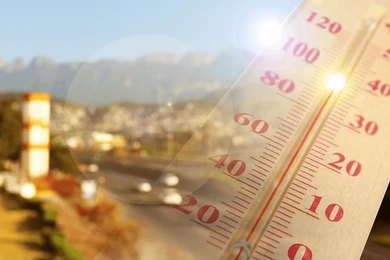
Germany’s deadliest week of the year wasn’t caused by war or disease — a single week of extreme heat in late June killed more than 4,300 people in one country alone.
Story Snapshot
- Germany’s Robert Koch Institute estimated 5,120 heat-related deaths in 2026, with most occurring during one week in late June.
- Germany’s Federal Statistical Office recorded roughly 30% more deaths in June than in previous years, with nearly 5,500 above the recent average in just one week.
- Germany set a new all-time temperature record of 41.7°C during the heatwave, and 99 people drowned in June — the worst toll in over two decades.
- The World Health Organization counted more than 1,300 excess deaths across all of Europe since June 21, while one estimate puts the continent-wide total near 20,000.
One Week, Thousands Dead
Germany’s Robert Koch Institute, the country’s top public health agency, reported on July 9 that an estimated 5,120 people died from heat-related causes in 2026. Most of those deaths happened during a single seven-day stretch. Between June 22 and June 28, roughly 4,310 of those deaths occurred, according to the institute. Germany’s Federal Statistical Office confirmed that excess deaths — meaning deaths above what would normally be expected — reached an estimated 6,800 during that same week.
The Federal Statistical Office also found that about 5,486 more people died in the last full week of June than the average for the same period from 2022 to 2025. Overall, deaths in June rose roughly 30% compared to prior years. Those are not small numbers. That kind of spike in a single month is the kind of thing public health officials usually only see during a major disease outbreak.
Record Heat and a Deadly Summer
Germany broke its all-time temperature record during the heatwave. Temperatures hit 41.7°C in the town of Coschen, near the Polish border in eastern Brandenburg, according to Germany’s national weather service. The heat didn’t just kill people directly. Ninety-nine people drowned in Germany in June — the worst monthly drowning toll in more than 20 years — as people rushed to rivers and lakes to cool off. Most of the drowning victims were young men.
Around 4,270 of the estimated 5,120 heat-related deaths were people aged 75 or older. Officials noted that more women than men died, largely because women make up a bigger share of the oldest age groups. People in that age range — especially those with heart disease or dementia — face the greatest danger when temperatures stay dangerously high for days at a time. Germany’s environment agency has long flagged adults over 75 as the group most at risk during heat events.
Europe’s Broader Toll
Germany was not alone. The World Health Organization’s director-general reported that more than 1,300 excess deaths were recorded across Europe since June 21, linked to the heat. A separate estimate from New Scientist put the continent-wide figure near 20,000. The gap between those numbers reflects different methods and data sources — the World Health Organization tracks real-time reports from member countries, while broader estimates use statistical models that take longer to compile but often capture more deaths.
#Europe records 10,000 excess deaths amid #extreme #heatwave
France, Germany, and Spain saw temperatures exceed 40°C pic.twitter.com/4BTRwVnmmr— Hans Solo (@thandojo) July 14, 2026
It is worth noting that the Robert Koch Institute’s figures are based on a statistical model, not direct death-certificate reviews. The agency says that pinpointing heat as the exact cause of death is not always straightforward. The numbers may be revised as more complete records come in. Even so, the scale of the spike — confirmed by two separate German government agencies — leaves little doubt that the June 2026 heatwave was one of the deadliest weather events Germany has seen in years. Heat of this magnitude has killed thousands before: Germany saw roughly 10,200 heat-related deaths in 1994 and around 7,600 in 2003. The 2026 toll fits a pattern that has repeated itself with increasing frequency over the past decade.
Sources:
reuters.com, lemonde.fr, latimes.com, trtworld.com, bbc.com