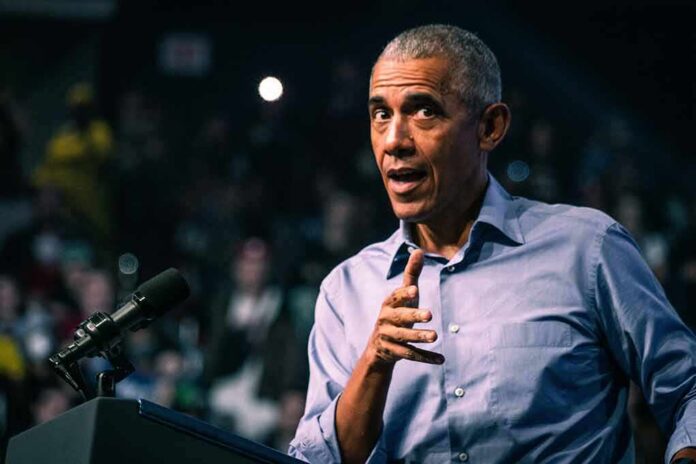
Former President Barack Obama accused Vice President JD Vance of pushing a “blood and soil” version of American identity, one that judges who belongs based on ancestry rather than shared belief in the country’s ideals.
Quick Take
- Obama made the comments in a taped interview with author Malcolm Gladwell, posted online Thursday.
- He said Vance’s July 4 speech echoed a view where “it matters who your parents were and how long they’ve been here.”
- Obama also pointed to Vance’s marriage to Usha Vance, daughter of Indian immigrants, calling the stance hypocritical.
- Vance’s actual speech focused on defending America’s founding story, not directly on immigration policy.
- The clash fits a decades-old pattern of leaders accusing rivals of exclusion while facing hypocrisy charges themselves.
Obama Names Vance Directly In New Interview
Obama did not hold back in his sit-down with Gladwell. He told the author that “the current vice president” gave a speech that amounted to “a ‘blood and soil’ version of ‘we the people,'” arguing that Vance’s rhetoric suggests belonging depends on parentage and how long a family has lived in the country. Obama framed this as a break from the founding idea that citizenship rests on shared values, not bloodlines.
The interview came out one day after the country marked the 250th anniversary of the Declaration of Independence, a milestone President Trump had formally proclaimed earlier in the week. That timing gave Obama’s remarks extra weight, landing right as the nation reflected on what it means to be American in 2026.
What Vance Actually Said On July 4
Vance delivered his Fourth of July address from the deck of a warship on the Hudson River. He urged Americans to “reject the view of your nation that sees only its sins, but not its grace and its greatness,” a line aimed at critics who focus solely on the country’s failures. Fox News described Obama’s attack as an indirect one, since Vance’s speech did not explicitly discuss ancestry or immigration length.
Reporters and commentators quickly noted the gap between Obama’s characterization and the speech’s actual content. Vance’s remarks centered on patriotism and national pride tied to America’s 250th birthday, not a policy statement about who counts as a “real” American based on family history.
The Hypocrisy Argument And Vance’s Marriage
Obama’s sharpest line targeted Vance’s personal life. He argued it was hypocritical for Vance to embrace an exclusionary framework while married to Usha Vance, whose parents immigrated from India. Critics on social media picked up this thread fast, with some accusing Obama of race-baiting and others defending the point as a fair callout of contradiction. Amanda Marcotte, a liberal commentator, asked publicly whether Vance is a hypocrite or simply anti-immigrant in a narrower sense.
The news is not surprising. I think many people already know about it. But one thing is clear: Benjamin only respects Donald Trump. He did not show the same level of respect to Barack Obama or Joe Biden. As for JD Vance, Benjamin wouldn’t care even if he tried to repair the…
— Golden Clem Hero (@hero_clem) July 21, 2026
Supporters of Vance pushed back hard, calling Obama’s framing unfair and accusing him of twisting a speech about national pride into a race-based attack. Online reaction split sharply along familiar lines, with some users defending Vance’s record and others amplifying Obama’s hypocrisy charge without added evidence.
A Familiar Pattern In American Politics
This kind of clash is not new. Since the late 1960s, American politics has repeatedly seen leaders accuse rivals of exclusionary “identity politics” while facing counter-charges of hypocrisy themselves. Research on moral judgment shows people tend to view the same behavior as more acceptable when done by someone in their own political camp, a bias that can deepen partisan divides over time.
That pattern helps explain why this exchange spread so fast online, even though Vance’s speech never used the phrase “blood and soil” or directly addressed immigration policy. Both sides read the moment through a lens shaped by years of prior fights over who gets to define what it means to be American.
Why This Fight Matters Beyond The Headlines
For voters exhausted by partisan theater, this episode is another example of leaders trading accusations instead of debating policy directly. Neither Obama’s claim nor Vance’s original speech addressed concrete immigration rules or citizenship law. Instead, the fight centers on symbolism and interpretation, feeding a cycle where Americans on both sides feel talked past rather than talked to about issues that actually shape their daily lives.
Sources:
facebook.com, hoodline.com, whitehouse.gov, heritage.org