Florida’s governor fight shows how party gatekeepers and national power can sideline a sitting governor’s plans.
Story Snapshot
- Ron DeSantis cannot run again in 2026, so the race to replace him is wide open [1][5].
- Republican leaders set strict debate rules that only Rep. Byron Donalds currently meets [11][12][16].
- DeSantis pushed for broader debates, signaling he is losing leverage over succession [12].
- Lieutenant Governor Jay Collins entered the race but trails the front-runner’s qualifications [2][11][16].
Why Succession Matters In Florida Right Now
Florida voters choose a new governor on November 3, 2026. State law limits governors to two straight terms, which makes Ron DeSantis ineligible this cycle [1][5]. That rule raises the stakes for who follows him and whether his policy gains endure. Florida remains a Republican stronghold after DeSantis won re-election by almost twenty points in 2022, flipping long-Democratic counties and cementing GOP control [4][5]. The Republican primary will likely decide the next governor, so control over that process carries outsize weight [5].
Ron DeSantis still holds the state’s top job and public platform, but formal power does not choose his successor. Florida elects governors and lieutenant governors as a joint ticket in both the primary and general elections, which means the next nominee sets the ticket, not the sitting governor [9]. That structure limits any handoff. It also means party rules, donor networks, and national endorsements can crowd out a governor’s preferred path, even if he stays popular at home [12].
The GOP’s Debate Rules Tilt The Field
The Republican Party of Florida set a “10-10-10” bar to make its official primary debates. Candidates must show at least ten percent in public polls, raise ten million dollars, and have ten thousand donors. Local and national outlets report that only Representative Byron Donalds meets all three marks so far [11][16]. Party officials cited those criteria in explaining why no sanctioned debate is set. That decision restricts exposure for rivals and can lock in the front-runner’s lead [12][16].
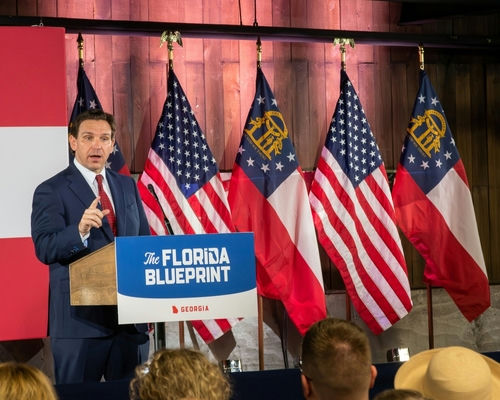
Ron DeSantis criticized the party’s approach and pressed for more open debates. Reporting says he remains a force but faces a legislature and party apparatus less eager to follow his lead as his second term winds down [12]. This clash shows the split between a sitting governor’s wishes and party gatekeepers who control stages, formats, and momentum. When stages shrink, donors and media turn toward the one candidate who qualifies, which can shape polls even more [12][16].
Who Is In The Running To Replace DeSantis
Lieutenant Governor Jay Collins launched a campaign to succeed DeSantis. Collins brings executive branch ties and military service, and he is the most obvious “continuity” option on paper [2]. But the Republican Party of Florida’s thresholds have, to date, left him off a sanctioned debate stage. That limits his reach compared with Representative Donalds, who already meets the party bar. In a primary where attention is currency, that gap matters week by week [11][16].
Representative Byron Donalds is the clear beneficiary of the rules. Video interviews and reports describe him as the only candidate meeting all three benchmarks, and as the race’s current Republican front-runner [11][18]. Supporters argue high standards show seriousness. Critics argue the bar was set to bless one candidate and shut down a contest. DeSantis’s call for more debates suggests he sees risk in a process that narrows choice for voters before summer [12][16][18].
What This Power Struggle Says About 2026 Politics
Florida’s fight mirrors a national pattern: a term-limited governor wants a say, but party rules, donors, and national figures can overwhelm that pull. Florida’s rules make succession an open contest rather than an appointment, so informal power is everything. The strongest recent data points are simple: DeSantis is barred from a third straight term, Republicans dominate statewide elections, and the party’s debate bar currently leaves only one candidate at center stage [1][4][5][11][16].
🚨Byron Donalds is RIGHT — No $10M? No 10%? Stay Off The Stage!🚨
If I were Byron Donalds, I wouldn’t waste time debating candidates who couldn’t even hit the basic bar: $10 million raised + 10% in polls.
You shouldn’t run for Governor if you can’t raise serious money or earn… pic.twitter.com/ZW9i62kJwr
— Reverend Jordan Wells (@WellsJorda89710) June 20, 2026
Voters on the right and left see something familiar here. A small circle sets rules. Those rules shape who the public hears from and when. The stakes are large: insurance costs, school policy, taxes, and growth are on the ballot in a state that often leads national trends. Healthy systems invite choice and debate. When process limits that, people suspect the game is rigged. Florida’s 2026 primary will test whether party controls or voter demand decide who follows Ron DeSantis [12][16].
Sources:
[1] Web – How Ron DeSantis Lost Control of His Own Succession
[4] Web – Florida gubernatorial and lieutenant gubernatorial election, 2026
[5] Web – Florida Governor Election Results 2022: Live Map – Politico
[9] Web – Governor Ron DeSantis | Executive Office of the Governor
[11] Web – Florida – National Governors Association
[12] YouTube – Florida gubernatorial primary heats up over GOP debate criteria
[16] Web – I’ve agreed to two debates by major local news stations, but DC …
[18] Web – DeSantis criticizes Florida GOP debate criteria – Miami Herald