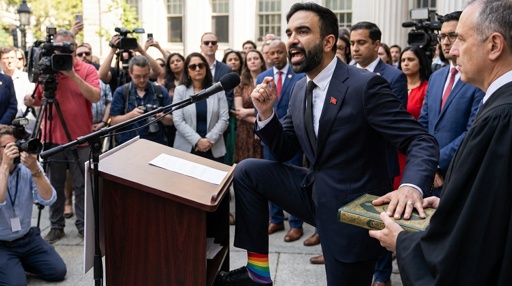
New York’s new mayor managed to turn a feel-good Jewish heritage party into a political loyalty test on antisemitism, Israel, and the future of urban liberalism.
How A Ceremonial Party Became A Line In The Sand
New York City mayors usually treat Jewish heritage events like political comfort food: speeches about shared values, kosher canapés, a few Hebrew words, everyone goes home smiling. Zohran Mamdani’s first Jewish Heritage event at Gracie Mansion landed very differently. Before the invitations were even fully digested, prominent Jewish leaders were on camera urging their colleagues to stay away, warning that attendance would send the wrong message at the wrong time.
Former state Assemblyman Dov Hikind, a veteran Orthodox Brooklyn politician, crystallized the pushback. He mocked the idea of “cheese blintzes at Gracie Mansion” as a photo-op for a mayor he accuses of hostility to Israel and disregard for Jewish safety. Hikind and allied groups argue that when antisemitic incidents spike on city streets and campuses, Jewish leaders cannot legitimize a mayor whose policies, in their view, systematically strip away protections and normalize extreme rhetoric.
The Record Behind The Backlash
The boycott call does not appear out of thin air. As a student and activist, Mamdani supported the BDS movement and aligned with campus groups that depict Israel as an apartheid state. On the campaign trail, he pledged to push New York City to divest from Israel Bonds and even mused about arresting Israel’s prime minister if the International Criminal Court ever issued a warrant. Those promises thrilled activists who see Israel as uniquely abusive but alarmed mainstream Jewish organizations that view such singling-out as discriminatory.
Once sworn in, Mamdani moved quickly. He revoked executive orders that had adopted the International Holocaust Remembrance Alliance definition of antisemitism and barred city agencies from boycotting Israel. Those orders were designed to give officials a clear framework for identifying when “anti-Israel” crosses into targeting Jews. Critics say scrapping them weakened institutional tools just as antisemitic incidents were climbing. Mamdani counters that earlier orders were politically tainted and blurred the line between speech and discrimination.
🚨 Deport Zohran Mamdani
Antisemitic hate crimes surging in NYC, yet Mayor Zohran Mamdani boycotts the Israel Day Parade — first mayor in decades to snub our Jewish community.
His wife Rama cheered Oct 7 as “breaking apartheid walls,” called the rapes a hoax, and ran deleted… pic.twitter.com/ZR3NBIgQG3
— Thomas Kellogg 🇺🇸 (@ThomasKelloggNY) May 16, 2026
Nakba Video And A Boiling Point
The immediate spark came from City Hall’s Nakba Day video. The clip focused almost exclusively on Palestinian displacement in 1948, presenting the creation of Israel as catastrophe without grappling with Jewish trauma, regional war, or decades of persecution that drove Jews toward a homeland. Jewish leaders such as Chabad activist Yaacov Behrman blasted the video as historically one-sided and reckless in a city where synagogues now need extra guards and Jewish students ride the subway looking over their shoulders.
From a common-sense conservative standpoint, the complaint is straightforward: when tempers are inflamed and Jewish institutions are on edge, a mayor should reduce temperature, not adopt the rhetoric of activist rallies. Giving taxpayer-funded megaphones to narratives that cast Israel as uniquely evil, without context or balance, encourages impressionable followers to see local Jews as stand-ins for a global villain. That is not the same as outlawing criticism; it is a demand for responsible leadership.
Security Fears Versus Progressive Signaling
Policy battles sharpen those fears. Jewish leaders lobbied for a bill requiring safety plans for protests near schools, a response to demonstrations that have marched right up to Jewish day schools with aggressive slogans. Mamdani vetoed that bill while allowing a similar measure protecting houses of worship to become law without his signature. He insists he is safeguarding protest rights. Many parents hear something else: that ideological purity matters more to City Hall than the safety of visibly Jewish children walking into class.
Compounding mistrust, Mamdani has been slow to condemn chants and slogans that many Jews interpret as calls for violence or erasure. Phrases like “globalize the intifada” may be defended by activists as metaphors for resistance, but they land very differently with families who remember bus bombings and café massacres. American conservative values tend to favor a bright line here: leaders should reject any language that reasonably sounds like a celebration of terror, especially when their own constituents feel targeted.
Competing Claims Of What Antisemitism Means
Mamdani and his defenders insist the entire controversy stems from an effort to shield Israeli policy from criticism. They point to his appointment of a progressive Jewish director for the Mayor’s Office to Combat Antisemitism and note support from anti-Zionist Jewish groups as proof that opposing Israel is not the same as hating Jews. They frame BDS as a nonviolent pressure campaign and argue that accusations of antisemitism are being weaponized to silence advocacy for Palestinians.
Jewish establishment groups answer that redefining antisemitism so narrowly that it excludes hostility to the world’s only Jewish state ignores lived reality. When every global crisis is laid at Israel’s feet, when no other country is treated as uniquely illegitimate, when Jewish institutions get vandalized after each Gaza headline, it strains credulity to call this “just policy debate.” From a common-sense perspective, motives matter less than outcomes: if rhetoric reliably correlates with harassment of Jews, leaders should rethink the rhetoric.
Why The Boycott Matters Beyond One Night At Gracie Mansion
Boycotting a ceremonial mayoral event is not a routine step. For decades, mainstream Jewish organizations and City Hall kept some relationship even through policy friction. The current boycott signals something more akin to a divorce. Leaders like Hikind are essentially saying: engagement has limits. If a mayor persistently undermines definitions and safeguards that Jews believe are essential to their security, then sharing a photo-op at Gracie Mansion looks less like dialogue and more like surrender.
The unresolved question is whether this rupture forces a course correction or cements a new normal. If Mamdani keeps his base while alienating much of organized Jewish New York, other ambitious progressives will notice. If the boycott expands, if donors and voters treat anti-Zionist maximalism as disqualifying, the political calculus shifts. Either way, a supposedly harmless heritage reception has exposed the fault line running under urban progressivism: how far can a city go in demonizing Israel without losing its Jews?
Sources:
Mamdani Nakba Day video prompts pushback from Jewish leaders amid rising tensions
Report: Pro-Israel activist urges boycott of Mamdani Jewish heritage event at Gracie Mansion
NYC Jewish leaders warn Mamdani over Israel stance and antisemitism concerns
Critics say Zohran Mamdani is antisemitic; he says he’s simply holding Israel accountable
Mamdani snub: Top Jewish groups refuse Zo’s invite after Nakba Day post