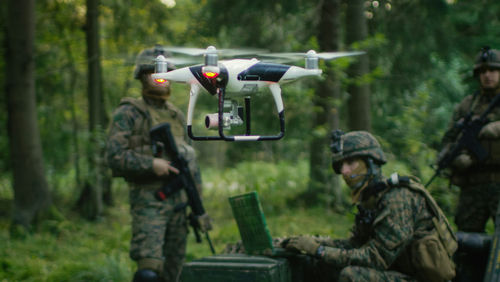
A little-known Pentagon office just asked for $54 billion to build swarming war robots, and Congress is being pressured to rubber-stamp it with barely any public debate.
Pentagon’s “Drone Command” Seeks Billions With Thin Public Scrutiny
The Department of Defense is asking Congress to supercharge the Defense Autonomous Warfare Group, taking its budget from roughly $225.9 million this year to nearly $54 billion in the 2027 request, a staggering increase of more than twenty‑thousand percent.[1][3] Pentagon budget summaries say this line would cover unmanned efforts across procurement, operations and maintenance, training, sustainment, and enabling technologies.[1] That single pot of money would rival or exceed entire service budgets, yet remains barely understood outside defense circles.[1][3]
A Pentagon official describes DAWG as the hub that will unify and mass‑produce drones and other unmanned systems for U.S. troops, consolidating efforts that were previously scattered across the services.[1] The fiscal year 2027 request is framed as the first time all unmanned efforts are coordinated under one oversight structure, with $53.6 billion tagged for procurement and support of unmanned capabilities over several years.[1] Supporters argue this centralization will prevent duplication and accelerate fielding, but the proof is not yet visible in operations.[1][4]
How DAWG Would Spend $54 Billion Over Five Years
Budget coverage indicates DAWG would have up to five years to obligate and spend the nearly $54 billion, with an option to accelerate that timeline to just two years if conditions demand faster fielding.[1][3] Officials say the plan is front‑loaded: early years would prioritize procurement, operations, maintenance, training, and sustainment to keep industrial production lines humming, then taper later to avoid overproduction.[1][3] That structure clearly aims to lock in a long‑term drone supply chain, not just buy a one‑time batch of hardware.
Reporting also shows this new office effectively absorbs the earlier Replicator initiative, which was supposed to deliver thousands of cheap, “attritable” drones but fell short of its public hype.[2][4] By rolling those ambitions into DAWG, the Pentagon is presenting this as an evolution rather than an admission of failure, yet details on lessons learned remain vague.[2][4] Large portions of the request are tied to research and development and reconciliation funding, blurring how much money yields near‑term, fieldable systems versus long‑range technology bets.[2][4]
From Human‑Led Warfighting To Swarming Machines
Alongside the budget spike, the Pentagon is backing new research projects to make autonomous systems smarter and more independent from vulnerable data centers.[4] Defense reporting highlights programs focused on “Materials for Physical Compute in Untethered Robotics” and “Decentralized Artificial Intelligence through Controlled Emergence,” designed to let drones think locally and form teams on their own to execute missions.[4] The stated goal is to allow a relatively small number of human operators to direct far larger numbers of robots across the battlespace.[4]
This shift is directly tied to what commanders have seen in Ukraine, Israel, and other flashpoints, where cheap unmanned weapons can overwhelm expensive platforms.[4] Pentagon planners argue that to keep American troops safe and maintain deterrence, the United States must dominate this domain with its own swarms and counter‑drone tools.[4] Yet current public evidence remains mostly budgetary and programmatic, not operational: there are no detailed test results or combat evaluations proving DAWG‑funded swarms are reliable, safe, and effective at scale.[1][2][4]
Opportunities And Risks For Conservatives Watching The Purse Strings
For constitutional conservatives, DAWG presents both an opportunity to strengthen deterrence and a warning light for unchecked bureaucracy. On one hand, concentrating resources on unmanned systems that keep American warfighters out of direct harm can align with a strong‑defense, peace‑through‑strength philosophy, especially after years of underinvestment in real capabilities and overinvestment in diversity trainings or climate posturing.[1][4] On the other hand, a $54 billion slush‑like account, heavily dependent on reconciliation, begs for tight oversight and clear performance benchmarks.[2][4]
🔴 Pentagon seeks $55B for autonomous weapons; senators say policy lags capability
The Trump administration is requesting $55 billion for the Defense Autonomous Working Group (DAWG), up from $225 million in the current fiscal year. The massive increase funds development of… pic.twitter.com/gUowoJBkxd
— NewsTongue (@NewsTongueX) May 20, 2026
Coverage already notes ambiguity around the exact scope of DAWG, with shifting figures between $53.6 and $54.6 billion and inconsistent descriptions of what counts as “all unmanned efforts.”[1][2][3] That fuzziness, combined with the Pentagon’s history of overpromising on speed and under‑delivering—seen in Replicator’s shortfalls—should push lawmakers to demand detailed line‑item justification, delivery milestones, and independent testing data before writing the check.[2][4] A strong Trump‑era Pentagon must still earn trust the old‑fashioned way: by showing results, not just budgets.
Sources:
[1] Web – Pentagon’s drone strategy puts $54 billion DAWG in the fight
[2] Web – Pentagon officials broadly detail $55 billion drone plan under DAWG
[3] Web – Funding for new autonomous drone warfare group … – Inside Defense
[4] Web – Pentagon seeks smarter, self-organizing drones as autonomous …