New York City’s Pride fight is no longer just about celebration. It is about who gets to belong, who gets to police the rules, and whether identity can be separated from the badge.
Quick Take
- Police Commissioner Jessica Tisch called Heritage of Pride’s ban on armed gay officers “hypocrisy.” [1]
- Heritage of Pride says its no-weapons rule applies to every group, not just the Gay Officers Action League. [1][2]
- Tisch has already shown support for armed LGBTQ officers by walking with them in Queens Pride. [2]
- The dispute reflects a deeper split over safety, trust, and police presence at Pride events. [7][14][17]
Why Tisch Fired Back
Jessica Tisch said Heritage of Pride wants police protection while blocking the very officers who represent the LGBTQ community. In her letter, she said it was “the height of hypocrisy” to ask for security from armed officers and then ban those same officers from marching. She also said New York Police Department rules require uniformed officers to carry their service weapons as a matter of public and personal safety.[1]
That made the policy clash sharper than a normal parade dispute. Tisch was not only defending the Gay Officers Action League. She was also arguing that the organizers were applying one rule to uniformed officers and another to everyone else. Heritage of Pride answered that the March has a no-weapons policy and that the group could join only without firearms.[1][2]
What Heritage of Pride Says
Heritage of Pride says its rule is about weapons, not identity. The organization told reporters that it updated the march guidelines so no participating contingent could march with weapons, and it said the Gay Officers Action League was welcome without them.[1][2] That matters because it weakens the claim that the group was singled out for being LGBTQ, even if the decision still angered many officers and supporters.
The history behind the ban also shapes the argument. Reporting on earlier Pride disputes shows that organizers first moved to restrict uniformed police after George Floyd’s murder and the backlash that followed.[7][14][16] That history gives the ban a clear political and social context. It also explains why some LGBTQ participants see armed police at Pride as a symbol of old harm, not shared safety.[17][20]
Why the Scene at Pride Mattered
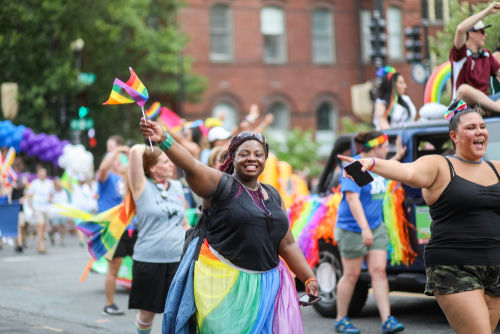
The image of Tisch standing with armed gay cops on the sidelines carried its own message. She had already walked with armed LGBTQ officers at Queens Pride, and she had publicly blasted the Manhattan organizers for blocking them.[2] Separately, the New York Police Department highlighted a Pride event at One Police Plaza with the Gay Officers Action League, showing that the department has continued to present the group as part of its public face.[3][4]
That contrast helps explain why the story struck a nerve far beyond New York. Support for police at Pride is not settled inside the LGBTQ community. A Williams Institute survey found 48 percent of LGBTQ adults supported police participation, 19 percent opposed it, and 33 percent were unsure.[17] The split is a reminder that Pride now sits at the center of a bigger fight over public safety, trust in institutions, and who gets to define inclusion.
Sources:
[1] Web – NYPD commish stands with armed gay cops on sidelines of NYC Pride …
[2] Web – NYPD commissioner slams NYC Pride ban on officers as ‘hypocrisy’
[3] Web – NYPD commish walks with armed gay cops in Queens Pride parade …
[4] Web – On Tuesday, @GOALny held a Pride event at One Police Plaza …
[7] YouTube – LGBTQ+ NYPD officer group wants to participate in Pride …
[14] Web – Heritage of Pride criticized for excluding NYPD from Pride parade
[16] Web – Police at Pride: how organizers and SF police came to a compromise
[17] YouTube – Transgender SFPD officer stands with police against SF Pride’s ban …
[20] Web – Police Participation In Pride – Out To Protect Incorporated