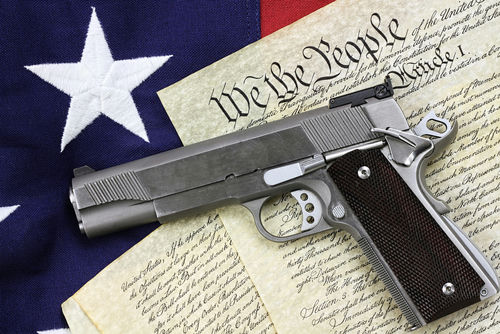
The Supreme Court just told the federal government it cannot strip gun rights from peaceful marijuana users simply for admitting they smoke.
Story Snapshot
- Supreme Court unanimously ruled the federal “drug user” gun ban cannot be used against ordinary marijuana users who are not dangerous.
- The justices said the government’s case against Texas gun owner Ali Hemani was inconsistent with the Second Amendment and lacked historical support.
- The ruling forces prosecutors to prove addiction, intoxication, or real dangerousness, not just status as a cannabis user.
- The decision is a major win for gun rights, but key limits remain, including truthfully answering federal gun forms and cases involving serious drug abuse.
Supreme Court Slaps Down Status-Based Gun Ban
The Supreme Court’s unanimous decision in United States v. Hemani is a clear warning to federal bureaucrats who think they can pick and choose which peaceful citizens get to exercise their Second Amendment rights.[2] Justice Neil Gorsuch, writing for all nine justices, held that prosecuting Ali Hemani under the federal drug-user gun ban, 18 United States Code section 922(g)(3), simply for using marijuana violated the Second Amendment.[2] The government had charged Hemani even though there was no evidence he was intoxicated, violent, or misusing the firearm. The Court said that kind of status-only ban goes too far under the Constitution.[2]
The government itself admitted that section 922(g)(3) “bans a class of people including Mr. Hemani from possessing essentially any firearm for any purpose,” meaning it directly burdens conduct the Second Amendment protects.[1] Under the modern test first laid out in New York State Rifle & Pistol Association v. Bruen, once a law touches protected conduct, the government must prove that rule matches our historical tradition of firearm regulation.[4] In Hemani’s case, prosecutors could not point to founding-era laws that disarmed ordinary, sober users simply based on what they consumed at home.[2]
Court: Marijuana Use Alone Is Not Enough To Take Your Guns
Justice Gorsuch’s opinion draws an important line between genuinely dangerous behavior and the government’s broad war on drugs.[2] The Court rejected the government’s analogy to old laws about “habitual drunkards,” stating bluntly, “To state the analogy is to expose its deficiency.”[2] Those historical rules targeted people who were actively incapacitated or causing trouble, not people who had a beer on Friday night. In the same way, the Court found no tradition of permanently disarming an otherwise law-abiding citizen who occasionally uses marijuana.[2]
An amicus brief from the Liberty Justice Center helped frame this history, explaining that the Founders recognized the authority to disarm those who were intoxicated or found by a court to be a credible threat, but there was no analogue for permanent disarmament of sober citizens based only on substance-use status.[4] The Court effectively agreed, stressing “there was no historical precedent for punishing occasional users in this manner.”[2] That matters in an America where tens of millions of adults live in states that have legalized cannabis in some form but still face a federal system stuck in the 1970s.[14]
“Unlawful User Plus” — What Still Lets Government Disarm You
Hemani is a win for gun owners, but it is not a blank check. The justices were careful to say that being an “unlawful user” of drugs, by itself, is not enough to lose gun rights.[2] Instead, there must be “unlawful user plus” something more, like real addiction, current intoxication with a firearm, or clear evidence that the person is dangerous.[2] In plain terms, peaceful marijuana users are not presumed dangerous. But someone whose drug abuse leads to crime, violence, or repeated impaired gun handling can still face restrictions consistent with the Second Amendment’s history.[2]
🚨 Can you use cannabis AND own a gun? The Supreme Court fight over the federal ban (§922(g)(3)) is heating up — and the Second Amendment may win. Tom & Miggy break down what every cannabis user needs to know about their gun rights. #cannabis #2A pic.twitter.com/TTDs3hGUUi
— tom howard (@tomweedlaw) June 23, 2026
The Court also kept important limits in place. It did not decide whether the law can still apply to serious drug addicts, leaving that for future cases.[2] It did not touch federal rules against people convicted of felony drug distribution.[2] And it did not change the fact that marijuana remains illegal under federal law, even if your state says otherwise.[3] That means the broader federal war on drugs continues, but now Washington cannot hide behind it to treat millions of ordinary gun owners as second-class citizens with fewer constitutional rights.
What This Means For Gun Owners And Federal Forms
For everyday conservatives who own guns and live in states with legal marijuana, Hemani is both a victory and a warning. Federal prosecutors can no longer sustain a section 922(g)(3) charge based solely on a defendant’s marijuana use, without more.[14] They must show some link to dangerousness. But the ruling does not erase federal paperwork traps. The Federal Bureau of Alcohol, Tobacco, Firearms and Explosives’ Form 4473 still asks whether you are an unlawful user of marijuana, and lying on that form is a separate federal crime under 18 United States Code section 924(a)(1)(A).[15] Hemani did not make it legal to lie; it made it harder for the government to criminalize honest, peaceful users just for owning a gun.[2]
Gun control activists have tried to downplay the decision as a narrow exception, insisting there is “no expansion” of rights for people they see as potentially dangerous.[3] But the real story for constitutional conservatives is different. The Court made it clear there is no “drug exception” to the Second Amendment when it comes to peaceful citizens.[7] Status-based bans and vague labels like “unlawful user” are no longer enough. The government must prove real danger rooted in history, not moral panic or political agendas. In a time of growing federal overreach, that is a meaningful check in favor of individual liberty and the right to keep and bear arms.
Sources:
[1] Web – SCOTUS Unanimously Ruled That the Second Amendment Trumps Anti-Drug …
[2] Web – UNITED STATES v. HEMANI | Supreme Court – Cornell Law School
[3] Web – [PDF] 24-1234 United States v. Hemani (06/18/2026) – Supreme Court
[4] Web – What’s at Stake in Hemani? Supreme Court Grants Cert to Review …
[7] Web – Last month, the United States Supreme Court heard oral arguments …
[14] Web – Supreme Court wrestles with gun rights, marijuana, and the right to …
[15] Web – Marijuana advocates light up Second Amendment fight at Supreme …