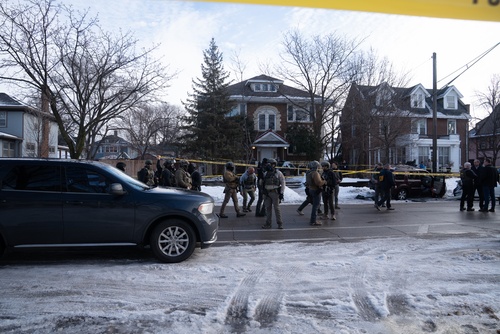
A quiet Iowa community is reeling after police say a 52-year-old man gunned down six of his own family members across multiple homes before killing himself during a confrontation with officers.[1][2]
Story Snapshot
- Police say 7 people are dead in Muscatine, Iowa, including suspected gunman Ryan Willis McFarland, after a domestic dispute turned into a family massacre.[1][2][4]
- Officers report six victims were found shot at three locations in the city, all believed to be related to the suspect.[1][2][4][5]
- Authorities stress there is no ongoing threat to the public, calling it a contained domestic incident, yet key records have not been released.[1][2][3]
- The case raises hard questions about family violence, mental health, and how early police narratives quickly harden into accepted truth.[1][2][3]
Police Describe a Domestic Mass Killing That Shattered One Family
Muscatine police say the nightmare began at a home on 210 Park Avenue, where officers responding to a welfare check discovered four people dead from gunshot wounds inside the residence.[1][2] Investigators quickly tied that scene to two more shootings across town, locating one male victim at 1509 Mill Street and another at 808 Grandview Avenue, both also dead from gunshot wounds.[1][4][5] Officials stated all six victims were believed to be family members of 52-year-old suspect Ryan Willis McFarland.[1][2][4]
Reports from multiple outlets say McFarland fled the Park Avenue scene before officers arrived, triggering an urgent citywide search that ended near a riverfront trail and pedestrian bridge.[1][2] There, police say they located the suspect and that he died from a self-inflicted gunshot wound during contact with officers, bringing the total death toll to seven.[1][4][5] Muscatine’s police chief emphasized that the shootings appeared rooted in a domestic dispute and that there was no ongoing danger to the broader community.[1][2]
Multi‑Agency Response, But Few Hard Records Released So Far
Coverage of the tragedy relies almost entirely on what the Muscatine Police Department has told the public so far, rather than on released reports or court records.[1][3][4] Local news accounts identify Muscatine Police as the lead investigators, supported by the Muscatine Fire Department, Muscatine County Sheriff’s Office, Iowa State Patrol, and the Iowa Division of Criminal Investigations, underscoring how seriously authorities are treating the case.[1][2] Police named Lieutenant David O’Connor of the Major Crimes Unit as the public contact, signaling an active, formal investigation.[1][3]
Despite the intense law-enforcement presence, key documentation has not been made public, including the full incident report, 911 call logs, autopsy findings, or any possible warrant affidavits that might reconstruct the exact sequence of events.[1][2][4] Media reports note that officers and reporters are still using careful language, saying the victims are “believed to be family members,” which suggests that full genealogical or forensic confirmation has not yet been released.[1][2][5] Minor inconsistencies have also appeared, including variations in spelling McFarland’s surname and some confusion around exact timing, showing how quickly early information can drift as it is repeated.[1][3][5]
How Domestic Mass Killings Fit a Disturbing but Familiar Pattern
The Muscatine case fits a broader pattern that researchers call domestic mass murder or familicide, where a perpetrator wipes out multiple members of his own family, often inside homes or otherwise private settings.[1] Past cases range from the Haynie family murders in Utah to historic Iowa tragedies like the unsolved Villisca axe murders, in which entire families were wiped out in a single night. These crimes rarely involve strangers; instead they reveal catastrophic breakdowns inside families that spiral into lethal violence.[1]
A mass shooting occurred in Muscatine, Iowa, leaving seven people dead, including the suspected gunman. Police believe the victims may have been members of the same family. pic.twitter.com/8FGzQgyvfa
— Dyonne (@kgpnet) June 2, 2026
Investigators and journalists know that in such cases, the early public story usually comes almost entirely from police briefings, long before full forensic files or psychological evaluations are available.[1][2][3] That is exactly what is happening now in Muscatine: a working narrative about a domestic dispute and family massacre has quickly solidified, even as authorities retain critical records because the investigation remains active.[1][2][4] For communities and policymakers who care about protecting families while respecting gun rights, the real work begins after the cameras leave, when the deeper questions about warning signs, mental health, and system failures must be faced.
Sources:
[1] Web – Iowa Gunman Kills 6 Family Members Before Shooting Himself: Police
[2] Web – Watch Family Massacre: Season 1 Free | Fandango at Home (Vudu)
[3] YouTube – New details emerge on strict, isolated life of family allegedly slain …
[4] Web – THE NEWTON FAMILY MURDERS – American Hauntings
[5] Web – Haynie family murders – Wikipedia